
Thought leadership best practices: Why getting personal works
A while ago this LinkedIn post came across my feed arguing that people shouldn’t post personal stuff on the platform.
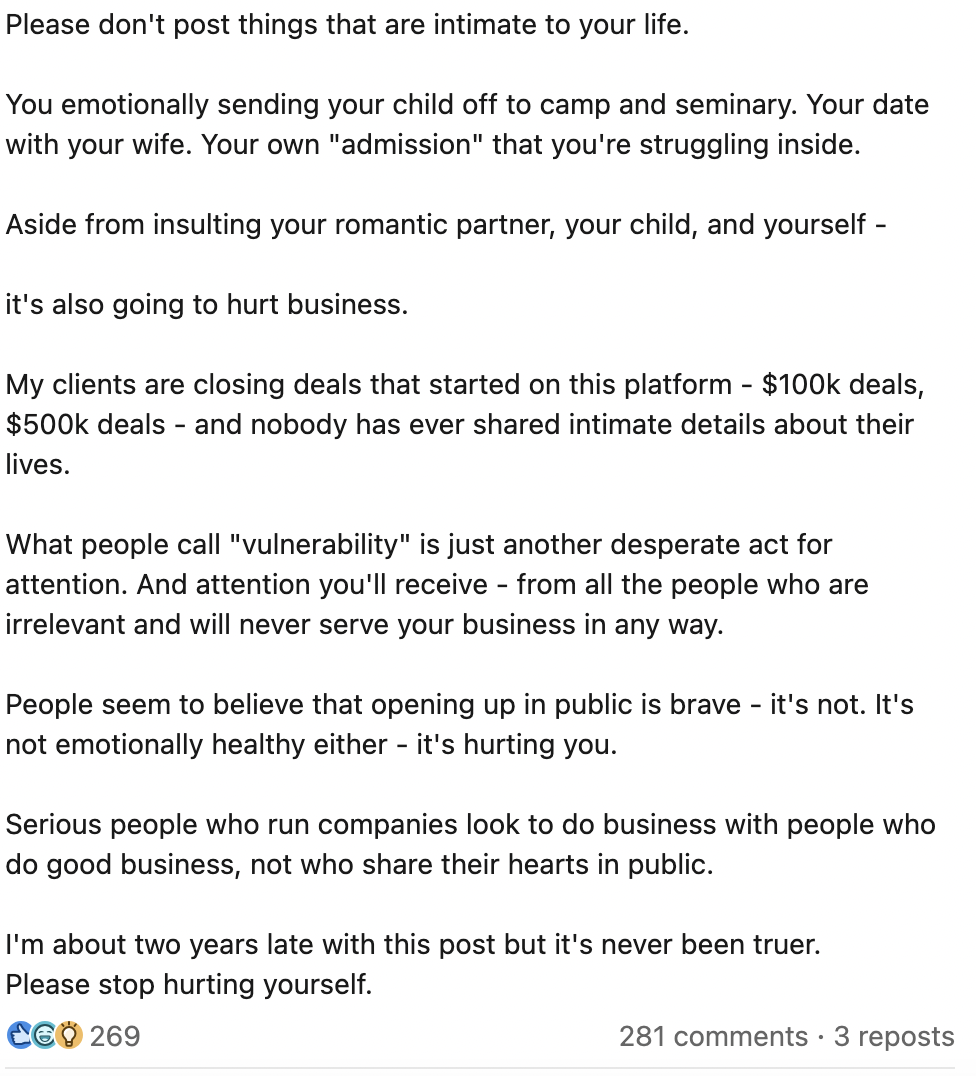
I couldn’t disagree more.
Okay, let’s not treat LinkedIn like Facebook and just post whatever random thoughts pop into our heads or using it for therapy. But linking personal events or insights to larger trends or ideas is the cornerstone of effective thought leadership content, whether you’re a marketing manager or a CEO.
It’s a well-established fact that people make decisions based on emotion, not just logic. Advertising copywriting leverages this truth. Apple’s slogan “Think Different” taps into its customers’ perceptions of themselves as creative iconoclasts, while Nike’s “Just Do It” lets us picture ourselves as athletes.
Thought leadership content marketing uses the same concept. But instead of a clever catchphrase, it uses the human experience to build emotional connection.
That could be “Taking care of my aging parents taught me that we needed to design our healthcare product/service to work better for people under high levels of stress.” Or, “I didn’t listen to what members of my team were trying to tell me, leading several valued employees to exit the organization.”
Should you post personal content on LinkedIn?
Personal branding on LinkedIn is not about being vulnerable just to be vulnerable. It’s about sharing something that resonates with others. This is why many personal essays go viral: readers realize, “Oh my gosh, I’ve felt this same way!” Maybe it even makes something nebulous click into place.
And it can be powerful: In a study by Edelman and LinkedIn, almost 75% of decision makers said an organization’s thought leadership content Is a more reliable foundation for evaluating its capabilities and competencies than other marketing or sales collateral.
To be clear, not every piece of thought leadership requires baring one’s soul. But don’t discount personal storytelling in marketing as a springboard to connection and trust.