
I've always thought of myself as a writer who ended up in marketing, which has sometimes felt like a strike against me. But recently I had a conversation that made me realize that might not be a disadvantage. Besides technical writing skills, the qualities that make someone a good writer—curiosity, empathy, understanding character and motivation—also translate to marketing.
For a while now, I’ve been reaching out to people on LinkedIn who offer complementary services to my own or who I think I could learn from, asking them if they’d be willing to have a half-hour chat. When I talked with marketing strategist Ardath Albee, we discovered we had a lot in common. She was also an English major and had zero formal training or education in marketing. And yet she’s still so much in demand and still so engaged after more than 25 years in the field that she recently took a full-time head of marketing job, even though she could retire if she wanted to.
“If I looked at marketing as marketing, I wouldn't have made it 20 years,” she told me. Instead, she used what she learned at writing workshops and retreats to approach marketing as a story. Like fictional characters, buyers have a problem, encounter obstacles, need information to move forward, worry about risks, and must decide to act. What problem are they trying to solve? What's standing in their way? What do they need to learn next?
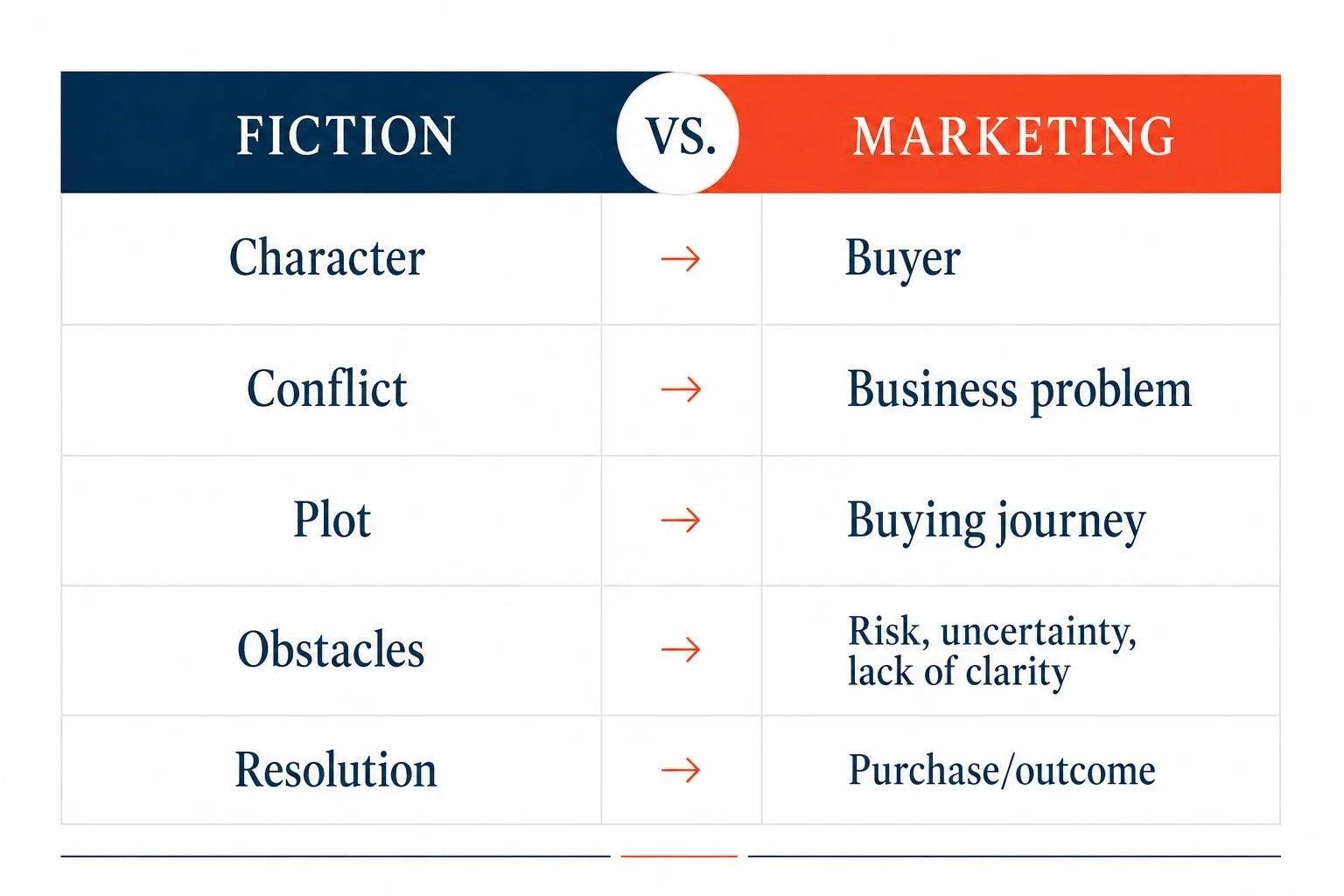
The marketer’s job, like a fiction writer’s, is to help them progress to the next step. This means focusing less on products and features and more on “what does this do for me?” as the buyer. While today’s buyer journeys tend to be less linear than a short story or a novel, the framework still works as long as all of the required elements are there and they connect to each other.
Why Buyer Research Matters More Than Ever
Another key piece to her success is her insistence on robust buyer research: actually talking to and observing customers instead of relying on AI or generic data. Besides the fact that you don’t know where AI is getting its data from, it’s just a pattern-matching tool. She points out that it can’t tell you the details of their decision process, who else they had to convince, the battles they had to fight, and what the tipping point was. Those little details are what makes an effective marketing strategy—not building on what’s been done before.
Obviously the idea of content marketing as storytelling is not new, but I love the way she applies it to the entire function—complete with developing characters and even subplots.
So in a content marketing environment that’s being saturated with generic AI-generated frameworks and slop, the answer is less trying to master every new tactic and technology (which is pretty much unsustainable in the long term) and more doubling down on understanding the human stories driving buyers.
Double-click to edit...